Webster ConnectedShared working spaceAccessible by link

READING & SIGNALS

Source. Signal.
Why it matters.
What it connects to.

A curated reading desk for bringing outside information into the conversation with its source, context and significance intact.

Curated, not exhaustiveSources + contextGrowing over time
THE PROPOSED METHOD

Read the source.
Identify the passage.
Name the signal.
Follow the question.

Begin with a source relevant to the work. A particular passage may reveal a signal—an idea, pattern or shift worth noticing. Naming that signal makes it possible to follow the question it raises without mistaking the source for a conclusion.

The purpose is not to turn every signal into a project. It is to determine whether the signal validates the current direction, connects to another thread, deserves further exploration or can close with greater confidence.

DOWNLOAD THE DRAFT FRAMEWORK
FIRST WORKING ENTRY

The draft framework applied to one outside signal.

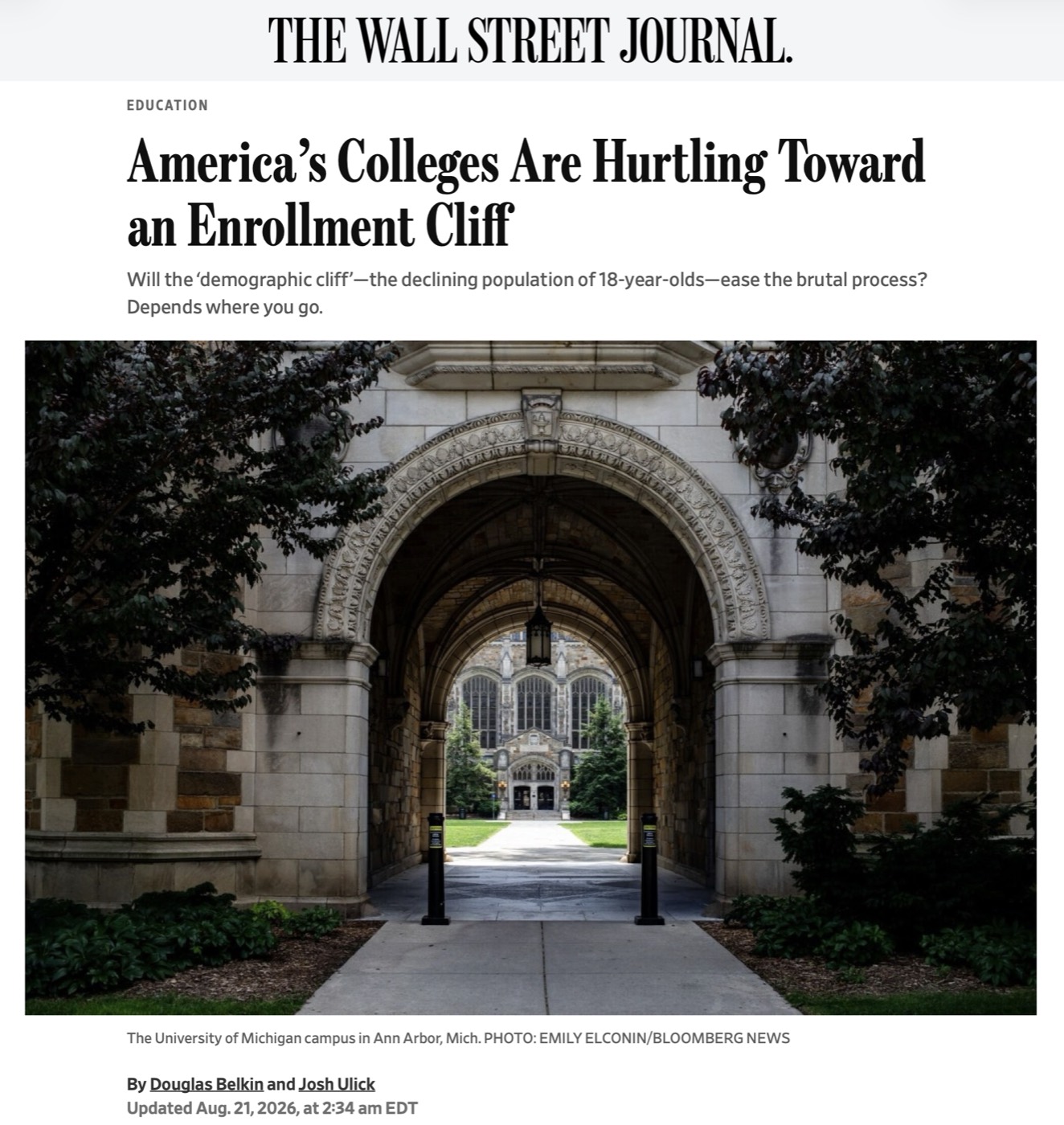
Wall Street Journal article about the approaching college enrollment cliff
Source preview · The Wall Street Journal
SIGNAL 01 · HIGHER EDUCATIONWORKING CONCEPT · FOR REVIEW

THE WALL STREET JOURNAL

America’s Colleges Are Hurtling Toward an Enrollment Cliff

PROMPTING PASSAGE

“a flight-to-quality, where the most sought-after schools are attracting an ever-growing number of applicants, while less-attractive schools draw fewer.”

Belkin and Ulick · The Wall Street JournalTHE SIGNAL

Demand is concentrating around institutions perceived as higher quality, while admissions choices are also shaped by factors beyond academics—including campus culture, athletic success and even weather.

THE QUESTION IT PROMPTED

In a flight to quality, who defines quality? Which internal and external perspectives shape that definition, and what evidence shows it has been earned?

This is a working concept for discussion and approval, not an approved Webster process, conclusion or decision.

READING & SIGNALS · WORKING CONCEPT

Flight to Quality

Review 01 · Working draft · September 2026

READING AND SIGNALS REVIEW

Flight to Quality

Apply the proposed Reading and Signals Review framework to an article about the approaching enrollment decline, concentrated demand and renewed scrutiny of the value of a college degree.

This is a working draft for review. It does not represent an approved Webster process or conclusion.
01
SOURCE

America’s Colleges Are Hurtling Toward an Enrollment Cliff

Authors
Douglas Belkin and Josh Ulick
Publisher
The Wall Street Journal
Publication
Updated August 21, 2026
02
NEUTRAL SUMMARY

The article describes a demographic decline expected to reduce the number of traditional college-age students in the United States. It cites a forecast that college enrollment will fall 13 percent by 2041 and notes that the effects have already begun in parts of the Midwest and Northeast.

The decline is not expected to affect every institution in the same way. Highly sought-after universities and several public flagships continue to attract growing applicant pools, while many regional and less-selective institutions have become easier to enter. The article describes this concentration of demand as a flight to quality.

It also connects enrollment choices to growing skepticism about the economic value of a college degree. Families are weighing tuition against employment prospects and longer-term opportunity. Institutional choice is influenced by factors beyond academic measures, including campus culture, athletic success and weather.

03
PASSAGE → SIGNAL

The article describes concentrated demand around schools perceived as more desirable. It also notes that campus culture, athletic success and weather can shape reputation and choice. Together, those observations identify a signal: perceived quality is influencing institutional choice, while the meaning of quality reaches beyond academics.

04
QUESTIONS RAISED

In a flight to quality, who defines quality? Which internal and external perspectives shape that definition, and what evidence shows it has been earned?

  • How does the university define and measure academic quality?
  • How do prospective students, current students and families define value, and where do their views align or differ?
  • What do employers, academic peers, partners and the press recognize and repeat about the institution?
  • How is validated value communicated over time without allowing the message to outpace the evidence?
05
RELEVANCE

A contracting market may intensify how students and families compare institutions. Selectivity can signal perceived quality, but it does not define academic quality. An institution can deliver strong academic work and still have difficulty making that value visible. The reverse is also possible: reputation can persist after the underlying experience has changed.

The relevant perspectives are not identical. The university may focus on rigor, teaching, faculty contribution and outcomes. Students may place greater weight on belonging, experience, opportunity and the future they can imagine. Families may emphasize support, affordability, risk and return. The inquiry is useful only if these perspectives are examined without assuming that any one tells the whole story.

06
EXISTING EVIDENCE

This working draft has not yet reviewed Webster’s internal evidence. Before proposing new research or communication work, the first step should be to identify what already exists and determine whether it answers the questions raised by the article.

  • Institutional definitions of academic quality, learning outcomes and student success
  • Accreditation materials, program reviews and other academic assessments
  • Enrollment, retention, completion and post-graduation outcome measures
  • Research involving prospective students, current students, alumni and families
  • Employer, partner and academic peer feedback
  • Brand, reputation, media and engagement research
  • Existing stories, publications and campaigns intended to make academic value visible
  • Current responsibility for maintaining, communicating and revisiting those messages

The evidence inventory should distinguish what the institution believes, what it can demonstrate, what its audiences experience and what they repeat.

07
ASSESSMENT

There is not enough information in the article alone to determine whether Webster has a gap or whether further work is warranted. The article provides a signal, not a diagnosis. The appropriate next step is a limited review of existing evidence rather than a new initiative.

If existing research and measures answer the question, the review can validate the current course and close. If the evidence is incomplete, outdated or inconsistent across audiences, a narrowly defined discovery effort may be justified.

08
DECISION AND INTENDED OUTCOME

The intended outcome is a clearer understanding of whether Webster’s academic value, institutional experience and external reputation tell a coherent story. The work should either confirm that the present direction is supported by evidence or identify a specific question that merits further attention.

If the evidence is clear, the next question is how that value remains visible. A durable approach would identify what belongs in a shared library, who contributes to the message, who maintains its coherence, what should be repeated and what evidence should cause the message to change.

DECISION RECORD · PENDING

Close · Validate · Continue monitoring · Explore further · Reconsider

For discussion and approval. This does not represent a final decision or an approved Webster process.

DOWNLOAD PDF
01
WORKING ENTRY ADDED

Webster + Walker

Institutional developments, program context and public material that help ground the conversation.

1 working entry
02
READY FOR CURATION

The World in Motion

Changes in technology, media, culture, work and learning that move through every industry, including sports.

Open shelf
03
READY FOR CURATION

Place + Experience

Ideas about campuses, districts, hospitality, convening and the environments where people gather.

Open shelf
04
READY FOR CURATION

Media + Learning

Examples of how conversations, research and lived experience can become useful and enduring content.

Open shelf
WORKING METHOD · FOR REVIEW

A signal is a reason to look—
not a reason to conclude.

The first entry demonstrates a proposed way to examine outside information without treating it as a diagnosis or turning it into a decision before the evidence is reviewed.